Aurora Heritage Planning
Follow us:





Recently, I was lucky enough to travel through northern India, visiting cities including Delhi, Jaipur and Udaipur, as well as smaller towns and rural villages. Among these places, one site stood out as a powerful reminder of how historic buildings can evolve while still honouring their past: Madhogarh Fort, in Rajasthan.
Perched on a rocky outcrop just east of Jaipur, Madhogarh Fort offers a compelling example of layered history carried carefully into the present day.
A fort shaped by conflict and continuity
The origins of Madhogarh Fort are generally traced back to the seventeenth century, when it was built as a strategic stronghold guarding the eastern approaches to the Jaipur region. Local accounts describe its involvement in regional conflict in the late eighteenth century, including a battle around 1787 that required the Jaipur ruler to mobilise forces in the area.
These stories are not just legend. During recent renovation works, cannonballs were uncovered within the fabric of the building itself. These discoveries reinforced the fort’s defensive role and provided tangible evidence to support long-held oral histories, grounding the site’s past firmly in the physical structure we see today.
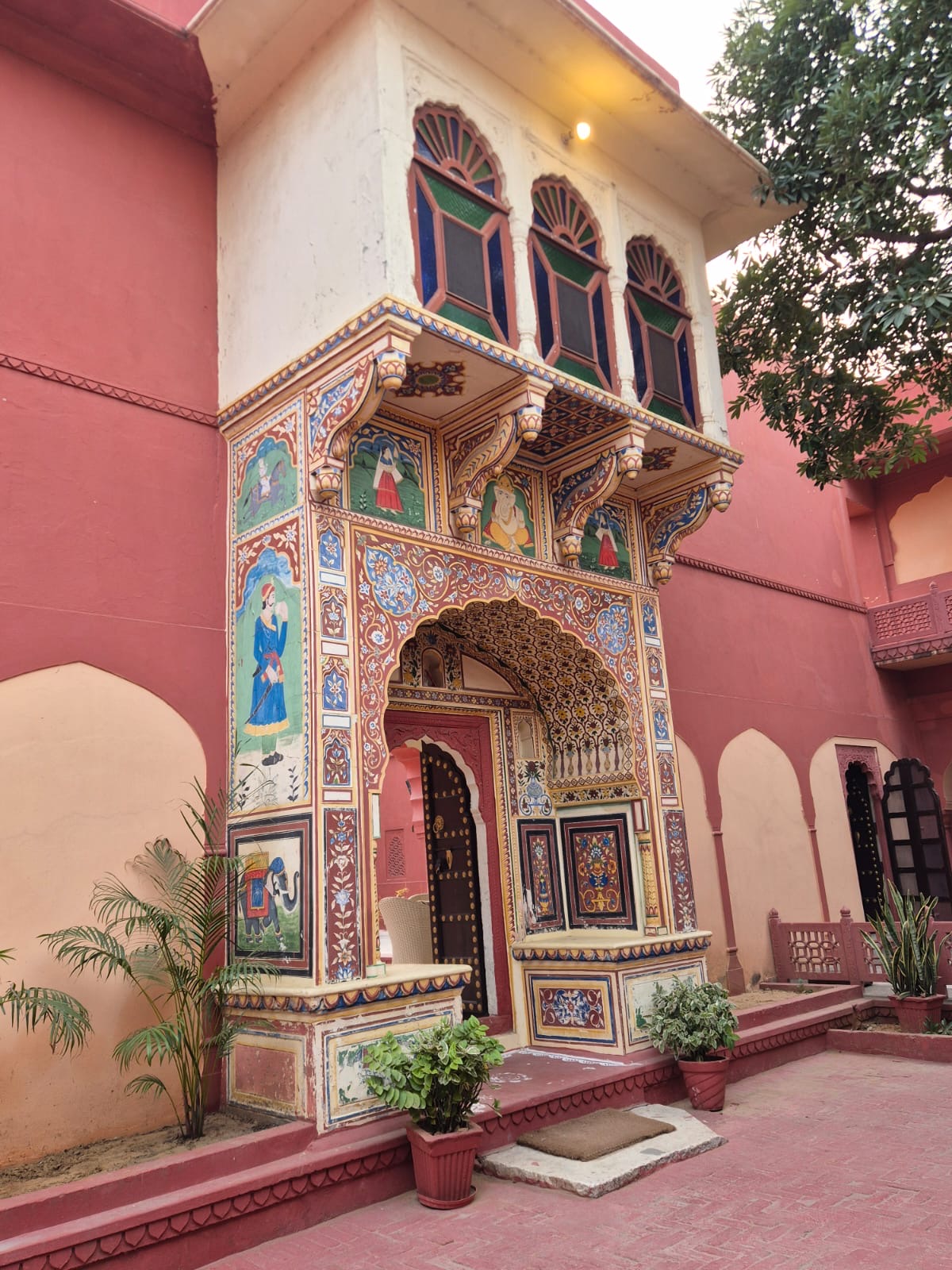
From family stronghold to heritage hotel
For generations, Madhogarh Fort remained in the hands of the same family, with the present owner’s father recognised as the last lord of the fort. By the early twenty-first century, however, the building faced challenges familiar to many historic structures: weathering, age and changing economic realities.
Around ten to fifteen years ago, a major decision reshaped its future. The fort was converted into a heritage hotel, allowing it to generate income while remaining in active use. This required modern electrics, plumbing and guest facilities to be carefully threaded through thick stone walls never designed for such systems.
It was a sensitive balancing act between preservation and practicality.
Restoration is never “finished”
The work did not end once the hotel opened. Increasingly heavy monsoon rains in recent years have caused persistent damp, repeated repainting and concerns around subsidence in parts of the structure. These ongoing issues highlight a crucial truth about heritage buildings: restoration is not a one-off event, but an ongoing relationship between people, place and climate.
Madhogarh Fort remains a living site, requiring constant attention to balance safety, comfort and conservation.
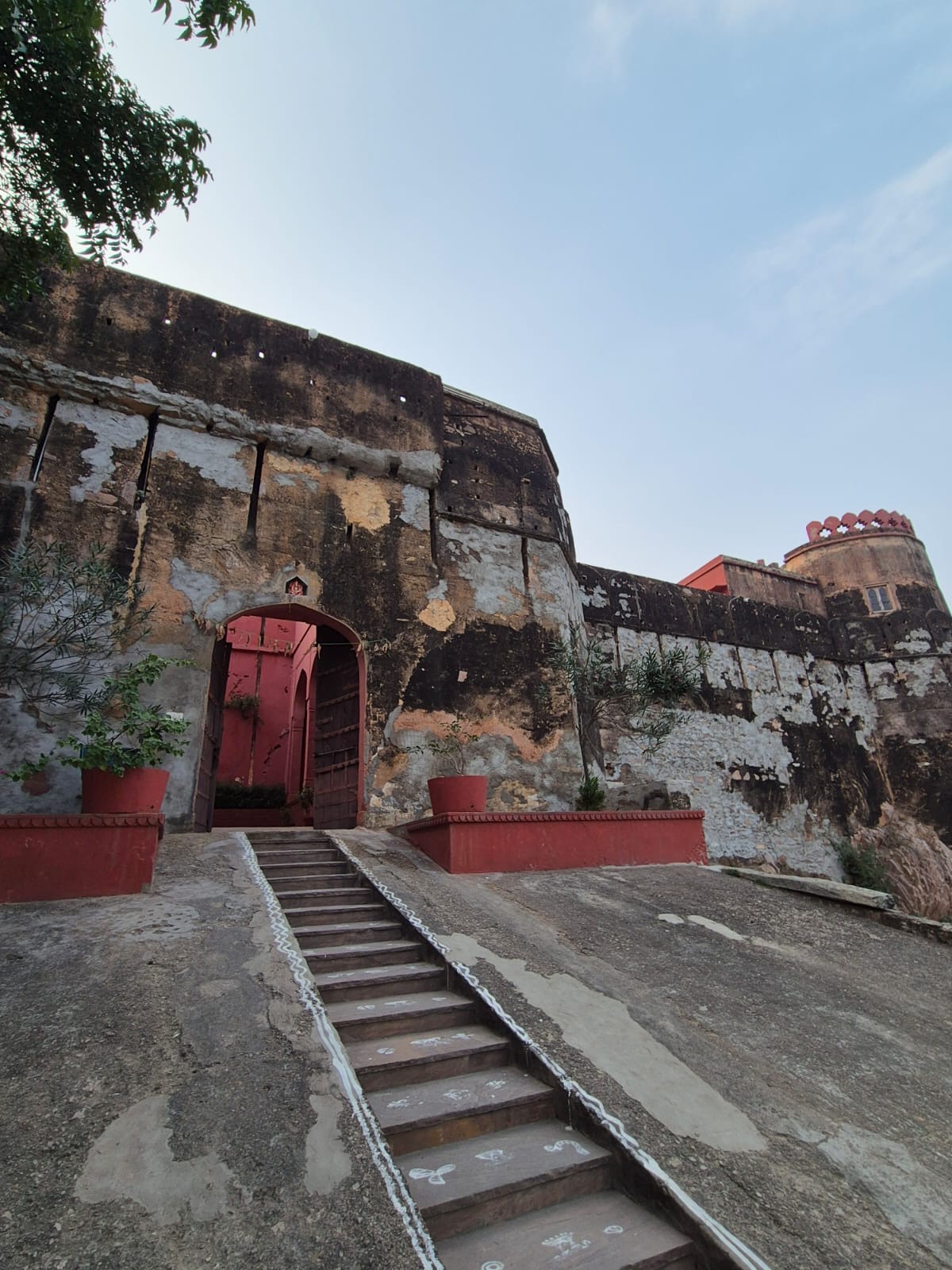
Keeping heritage socially relevant
Today, the fort’s role extends far beyond accommodation. Its courtyards and terraces host destination weddings, film shoots and cultural events. Visitors can also take part in curated experiences such as cycling routes through the surrounding countryside and regional food and drink pairings.
These uses are about more than income. They keep the fort socially relevant, ensuring it remains embedded in everyday cultural life rather than frozen as a static monument.
A wider shift in heritage thinking
This approach reflects a broader shift in Indian heritage policy over the past two decades. Government-backed schemes have encouraged the adaptive reuse of forts and palaces as heritage hotels, with two clear aims:
Similar thinking can be seen closer to home.
Parallels with the UK heritage landscape
In the UK, historic buildings are increasingly sustained through carefully managed change. Castles, manor houses and industrial buildings are being repurposed as hotels, cultural venues and mixed-use spaces under guidance from organisations such as Historic England and the National Trust.
The underlying philosophy is the same. Heritage is not a fixed artefact, but a living resource that gains meaning through continued use. Whether in rural England or Rajasthan, historic places face shared pressures: climate change, funding constraints and evolving public expectations.
The challenge remains universal: how to honour the past while allowing historic places to remain useful, valued and inhabited in the present.
An honest model of adaptive reuse
Madhogarh Fort does not present a flawless restoration story. Peeling walls and visible repairs are reminders of its vulnerability. Yet this honesty is part of its strength. The fort stands as a powerful case study in how heritage can be sustained through adaptation, care and realistic expectations.
Rather than pushing history into the distance, it invites people to inhabit it and, in doing so, to contribute to its ongoing survival.
Thinking about change of use in the UK?
If you are considering turning a heritage asset into a hotel, or are exploring a change of use for a listed building in the UK, we would be happy to help.
At Aurora Heritage Planning, we support clients across the UK with:
If you’re weighing up what’s possible for your building, please do get in touch.
This privacy policy applies between you, the User of this Website and Aurora Heritage Planning Ltd, the owner and provider of this Website. Aurora Heritage Planning Ltd takes the privacy of your information very seriously. This privacy policy applies to our use of any and all Data collected by us or provided by you in relation to your use of the Website.
Please read this privacy policy carefully.
Definitions and interpretation
Data
collectively all information that you submit to Aurora Heritage Planning Ltd via the Website. This definition incorporates, where applicable, the definitions provided in the Data Protection Laws;
Cookies
a small text file placed on your computer by this Website when you visit certain parts of the Website and/or when you use certain features of the Website. Details of the cookies used by this Website are set out in the clause below (Cookies);
Data Protection Laws
any applicable law relating to the processing of personal Data, including but not limited to the Directive 96/46/EC (Data Protection Directive) or the GDPR, and any national implementing laws, regulations and secondary legislation, for as long as the GDPR is effective in the UK;
GDPR
the General Data Protection Regulation (EU) 2016/679;
Aurora Heritage Planning Ltd, or us Aurora Heritage Planning Ltd, a company incorporated in England and Wales whose registered office is at Hull.
UK and EU Cookie Law
the Privacy and Electronic Communications (EC Directive) Regulations 2003 as amended by the Privacy and Electronxic Communications (EC Directive) (Amendment) Regulations 2011;
User or you
any third party that accesses the Website and is not either (i) employed by Aurora Heritage Planning Ltd and acting in the course of their employment or (ii) engaged as a consultant or otherwise providing services to Aurora Heritage Planning Ltd and accessing the Website in connection with the provision of such services; and
Website
the website that you are currently using, auroraheritageplanning.co.uk, and any sub-domains of this site unless expressly excluded by their own terms and conditions.
Scope of this privacy policy
Data collected
How we collect Data
Data that is given to us by you
in each case, in accordance with this privacy policy.
Data that is received from third parties
Data that is received from publicly available third parties sources
Data that is collected automatically
Our use of Data
in each case, in accordance with this privacy policy.
Who we share Data with
in each case, in accordance with this privacy policy.
Keeping Data secure
Data retention
Your rights
Transfers outside the European Economic Area
Links to other websites
Changes of business ownership and control
Cookies
Type of Cookie
Purpose
Analytical/performance cookies
They allow us to recognise and count the number of visitors and to see how visitors move around our website when they are using it. This helps us to improve the way our website works, for example, by ensuring that users are finding what they are looking for easily.
General
Changes to this privacy policy
You may contact Aurora Heritage Planning Ltd via the Contact page.
5 February 2024
.svg)


.svg)

.svg)